WHAT YOU SHOULD KNOW ABOUT MUSIC
Prologue
I learned music theory because it was a requirement for studying Classical piano. I found it dry and uninteresting. People didn’t write music that way. I also played rock music with my friends and jazz with my uncle. Rock and jazz had a completely different approach than Classical piano, focused on chords.
In university, I studied Physics. When I was a 4th year undergraduate, I was asked by a professor who knew I had a music background, to work as a tutor for a course on the physical basis of music that he was teaching to the 4th year Honours Music students. To my surprise, I learned a lot.
Many years later, when my son was learning music theory while studying Classical piano, I decided that someday I would write a book that taught music theory the way I thought it should be presented. I published the first edition of that book in 2012 as a multimedia epub for the Apple iPad. In this second edition, I have included more content and more examples.
The first 7 chapters of this book deal with music theory. We start bottom-up discussing the physics of sound and end with a top-down view of the anatomy of a musical composition. The last 4 chapters discuss related topics that complete what you should know about music.
Here is a brief descrption of each chapter:
Chapter 1 – The Physical Basis of Music
We start with a chapter on the physical basis of music because I want the reader to appreciate that there is a reason that music is the way it is. It isn’t arbitrary and it isn’t an accident. This will require some understanding of what standing waves and harmonics are. They are the basis of how every musical instrument works, and they are responsible for the small number of chords and notes that we use, out of an infinite number of possibilities. This book isn’t meant to be technical, so I made this chapter as succinct as possible.
Chapter 2 – The Western Scale
Next, I explain how harmonics lead to the chords and notes that we use in music. But using these notes presented a problem – instruments had to be tuned to each key individually which was tedious and time-consuming. This was fixed by the development of the Western Scale. During Bach’s time, this was very controversial, but now the Western Scale is universally accepted for all types of music.
Chapter 3 – Notation and Terminology
To document how to play a piece of music, we need:
- a way to show the pitch of each individual sound to be played
- a way to show when each sound is to be played, i.e., the sequence in time
- a way to show how long each sound is to be played
- a way to show periods of silence
- a way to show how fast to play
- a way to show dynamics, i.e., how loud or soft to play
- a way to show articulation, e.g., how forcefully or smoothly to play notes
Chapter 3 explains the notation used to accomplish this.
Chapter 4 – Chords
There are four types of basic chords derived from the Western Scale. There are also compound chords using other notes in the scale (commonly referred to as “jazz chords”). These chords are very familiar to rock and jazz musicians, less so to Classical musicians. Rock and jazz use guitars and keyboards, which play multiple notes at once, i.e., chords. Orchestral instruments (violins, clarinets, flutes, trumpets, etc.) play one note at a time.
Understanding what chords are, and where they came from allows us to discuss the anatomy of a musical composition. This is covered in the next three chapters.
Chapter 5 – Melody, Rhythm, Harmony
There are three elements of a musical composition. They are melody, harmony, and rhythm. This chapter explains exactly what they are, and how they are distinguished from each other.
Chapter 6 – Chord Progressions
The harmony of a musical composition can be viewed as a progression of chords. Before writing this book, I analyzed the chord progressions of the pieces found in Rolling Stone magazine’s “500 Greatest Songs of All Time”. I wasn’t surprised to find that the simplest chord progressions were the most common. It isn’t because rock musicians don’t know many chords; it is because the human ear prefers simplicity. In this chapter, I provide many examples of well-known pieces that use the most common chord progressions.
Chapter 7 – Form
This is the top-down view of a piece of music. For example, a piece could have verses consisting of chord progression A, followed by a chorus with chord progression B, followed by the final verse with chord progression A. This is called ABA form. Examples of the most common forms are examined including many examples of well-known pieces.
Chapter 8 – Hearing and Voice
This chapter explains how human hearing works and how the human voice produces sounds.
Chapter 9 – Musical Instruments
This chapter discusses how common instruments work. Examples are chosen from the string (piano, guitar, violin), woodwind (clarinet, flute), brass (trumpet), and percussion (drums, cymbals) families. The pipe organ is also explained.
Chapter 10 – Synthesizers
Today, synthesizers are ubiquitous. I bought my Roland D-50 in 1988. It was fantastic – and it still is. It is exciting to realize all the sounds that synthesizers are capable of creating. This chapter explains the common types of synthesizers and how they work. Many examples of music created using these synthesizers are provided. The chapter ends with an overview of the MIDI protocol that allows musical instruments and computers to communicate.
The last chapter contains a brief overview of how music is produced.
Chapter 11 – Music Production
For music to be performed, a written score is required so that every musician is “playing from the same song sheet”. When a performance is recorded, the music is digitized using sampling and stored as an audio file, e.g., .wav or .mp3. An arranger may reorganize the music, adding instruments and sounds, to create a better result. A mixer is used to combine multiple input audio tracks and to apply audio effects. The resultant audio may undergo further processing with the result being the “master” that is replicated to create Compact Discs (CD) or audio data files used for streaming. The capabilities of Digital Audio Workstations (DAWs) are described.
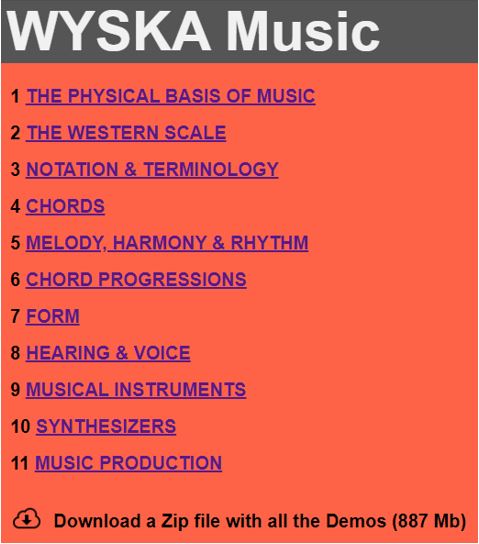
Finally, a few notes about the formatting. Paperback format was chosen for the second edition in order to provide a better presentation of the tables and figures. However, since there is no audio or video content in a paperback, this is provided externally by accessing the website:
www.cjohnwherry.com/wyskam
This is what that web page looks like:
Throughout the book, you will see icons like this:

If you choose the hyperlink beside 3 in the web page above, you will see the following web page that contains all of the Chapter 3 demos including Demo 3.3:
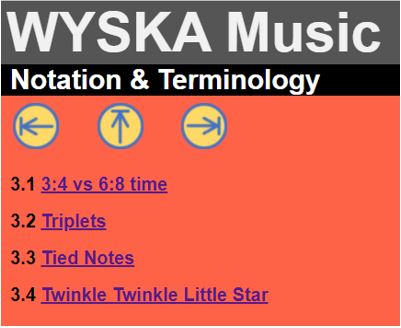
Select a hyperlink to play a demo. The buttons can be used to navigate:
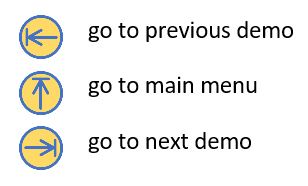
There are over 100 audio and video demos. Accessing this website allows the reader to watch and listen to the demo videos and audio clips on their personal computer, smartphone, or tablet, while reading the book.
If you are using a desktop, you can select the download button:

This downloads a Zip file containing all the demos into the “Downloads” folder.
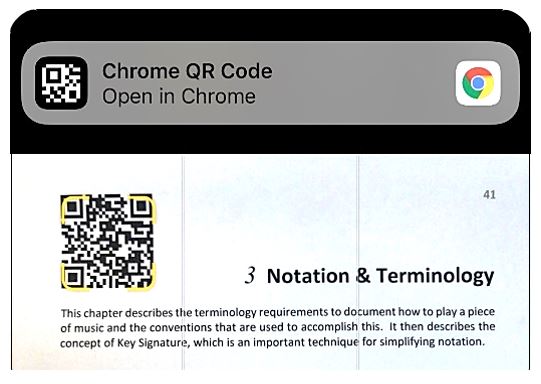
If you are using a smartphone or tablet, you can use its camera to detect the QR code at the start of each chapter. A popup will appear, allowing you to access the web page with this chapter’s demos without having to type in a URL. In the example shown on the right, the web page with the Chapter 3 demos shown above will appear.
Many of the demos that have been created contain portions of familiar pieces. These pieces have been explicitly chosen in lieu of my creating original content, because having some familiarity with the music helps with the understanding of the concept presented. Using extracts of copyrighted material constitutes “fair use” when the purpose is pedagogical. No rights are claimed over any of the copyrighted materials employed.
In this book, I have tried to make music theory interesting. I sincerely hope that the reader will find the content informative and enjoyable, and the presentation appealing.
C. John WherryToronto, Canada
October 2021